Decoy Rigging: More Than a Weight on a Bit of String
- 14/05/2026
Written by Paul Stenning
I was very proud of my first decoy purchase; I'd certainly pedalled a few miles delivering papers and pamphlets to buy my half dozen Italian-made plastic mallard decoys.
As good as they looked sitting on the lawn at home, opportunities to use them were limited as a 14-year-old, so I was very excited when my cousin, Alan, asked me if I wanted join him and his mate Gainsy on a local tidal river duck hunt.
There was a lot to be excited about, not only would I get to use my new decoys in a place we were likely to actually shoot some ducks but also because I would be hunting with what, through my young eyes, were a couple of absolute legends.
This was well before my cuzzie, Alan Hammond, would become widely known to everyone else as the waterfowl hunting legend and master game bird call maker. Alan's mate Kevin Gains also held hero status for me, he was the Southland rugby half-back and achieved some higher honours… but I was in awe of the rugby stories he could tell on a hunt.
When Gainsy's pulled up at Alan's house early in the morning I was ready and waiting with my hunting gear and bag of new decoys. I was about to add my bag of decoys to the sacks of decoys already in the 12-foot tinny on the trailer when Gainsy looked at them and said: "No point bringing them, they're not rigged right." It was said in such a tone I knew there was no point arguing – even though I wanted to.
How could they not be rigged right? The decoys had brand new long strings and heavy weights. Surely decoy rigging couldn't be any more complicated than that.
I was even less impressed when we were setting out the decoys from the dingy. Alan was on the oars and my job was to take the decoys out of the bag, unwind the strings and hand them to Gainsy so he could place them – they were just strings wrapped around the keel with weights attached which looked no different to mine, except my decoys were newer and much more realistic looking compared to Gainsy's well-used collection.
My disappointment was soon forgotten as the hunting began. I remember it as an action-packed morning. A good wind and incoming tide put plenty of ducks in the sky, giving us regular action with birds' wings cupped coming in. Then about mid-morning things got a lot tougher, especially for a 14-year-old shooting a 20-gauge as the ducks became reluctant to decoy, flying past the spread at longer ranges and landing well downstream of us.
Alan did not seem fazed: "Better go sort those dekes," he grunted as he and Gainsy headed off to the dingy. I was about to learn one of the many important lessons Alan taught me through my formative years as a waterfowler…
Adjustable Rigging
During the first part of the morning the decoys were anchored from the front or head end and were facing into both the wind and incoming tide. When the tide turned the outgoing flow was stronger than the wind, so the decoys swung around with their anchored front end facing into the current and tail end facing into the wind. "You won't decoy birds with the wind up their bum," Alan said in response to my puzzled look when he returned to the blind.
What I hadn't noticed about the rigging on Gainsy's decoys was that instead of the string being tied to the front hole of the decoy keel (as mine, like most decoys, were) the line was tied to form a snug loop around the decoy keel with a clinch knot. That enabled the knotted end to be slid around from the front of the decoy keel to the back of the keel, in effect acting the same as having the anchor rope tied to the back of the decoy.
With the decoys now facing into the wind, as resting ducks on water generally do, we finished the morning as it had begun with some nice decoying birds. I had certainly learnt that there was more to this decoy rigging caper than I had thought.
Challenges and Lessons
Over the years I have had to put a lot of thought into how I am going to rig my spreads with some challenges to overcome. There have been new decoys with different bases and keel designs, new lines that tangle less and are crimped instead of being knotted, also the arrival of motion decoys to contend with.
Add to that the places I hunt have changed – where sometimes we are hunting out of a boat and others we need to walk long distances. Then we have had to deal with high winds, strong currents, soft mud, deep water, shallow water or constantly changing tidal water, drifting weed mats and even ice sheets all with the potential to ruin a potentially good hunt if you have not rigged your decoys right.
Make your decoy anchor and line rigs easy to remove and put on another decoy because if you are like me you will always find there are 'better' must-have decoys coming out that you want to upgrade to. Also, a good line and weight set up will outlast most decoys, so making them easily transferable makes the process much easier without having to cut line and retie knots.
To do this I use a large snap swivel, not only does this make changing over decoy lines much easier (or attaching to a different anchor point on the decoy) but it also helps prevent tangles in your decoy line. Another advantage of using a snap swivel to attach the line to the decoy is you remove the weak point where decoy lines can fail from the knotted line rubbing against the keel.
I like to have some way of securing my anchor to the decoy while being stored and transported, especially if you are not using individually slotted decoy bags. Not only does this protect the paint or flocking on your decoys but it also eliminates those big tangles which are never a good way to start a morning hunt.
This can be achieved by using commercially available stretchy cords attached to J-weights which, once the line is wound onto the keel, can be stretched to lock the weight into the end of the decoy keel. There are many do-it-yourself options for achieving the same result by using rubber strips or bungee type cord with a homemade J-weight.
The other option which can be used with any anchor type is to cut strips of car inner tube into big rubber bands. Tie the decoy line to one end and I generally cable tie the anchor to the other end. Once the line is wound onto the keel the rubber band can be stretched over the keel (or around the body) and although it's a little slower to put out and pick up compared to the J weights, it is a very economical way to avoid those frustrating tangles.
Line Length
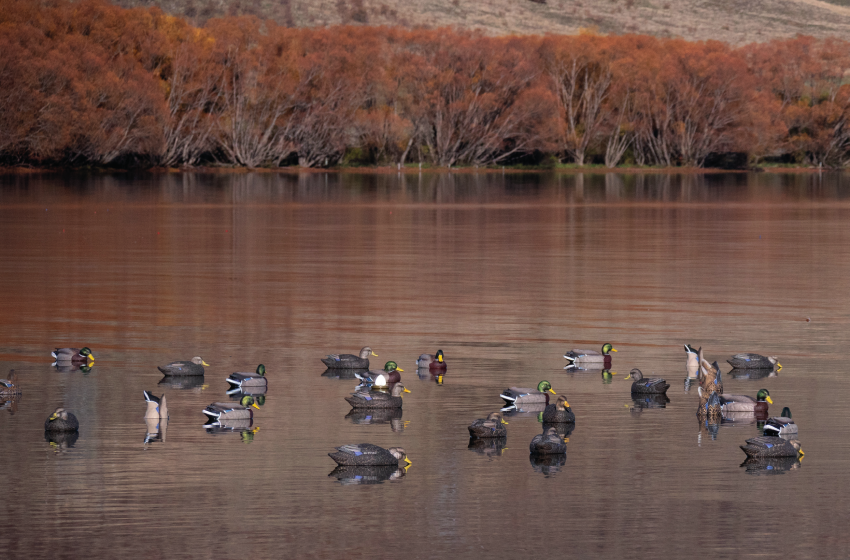
Another important consideration is how long decoy lines should be. I want my decoy lines to be about 1.2 to 1.4 times the depth of the water. This allows the decoy some natural movement and to rise and fall in choppy water without bouncing the anchor. More importantly, it allows me to have my decoys set quite close to each other without banging together or tangling up. One of the biggest faults I see in many decoy spreads is having decoys spread out well apart over a big area like checkers on a checkerboard.
There is a common belief that ducks that are spread out are relaxed and those in in tight groups are nervous or spooked. I don't believe this is the case in a hunting situation. Mallards are very gregarious and stay close and interact with each other. I like to have my decoy spread made up of tight groups with occasional pairs spread out with plenty of open spaces for the birds to land between. This also makes it easier to add movement or ripples to the groups and bring them to life rather than a larger area with motionless decoys.
Having the correct decoy line length allows you to place or throw with certainty and not have them drift into other decoys or move considerably with a wind change. It also reduces the chance of your dog getting tangled in or towing decoys while retrieving if the line goes pretty much straight down from the decoy.
All this is straightforward if you mainly hunt somewhere with a consistent depth of water. Hunting multiple places with different water depths, or changing water depths in tidal areas, is one of the biggest challenges. Simply having lines long enough for the deepest water you hunt can be an issue when you are hunting shallows.
Many decoys now come out with a notch built into the keel to hold your partially wound out decoy line, these are a great innovation although I have found them not that reliable at locking the line at a certain length – the line can come free when throwing your decoys or when it is extremely windy or choppy, resulting in your decoys slowly unwinding and tangling with others.
A simple solution to overcome this is a small strip of good quality duct tape (or similar waterproof tape) put over the notch holding the line.
Before the season I set my decoys up for the depth they will be used on Opening Weekend, which is about waist depth so I can reach them comfortably in chest waders. Quite often they stay this way for most of my hunting during the season. If during the season I am going to do a hunt which requires long lines, before the hunt I peel back the duct tape, unwind the decoy line to the desired length, then reseal the tape over the notch. Surprisingly, that piece of tape can last several seasons.
Anchor Weight and Types
Along with hunting different depths, hunting in strong currents, high winds or where floating seaweed or other organic matter can build up on your line, taking away your decoys, can make life difficult. This makes choosing what weight your decoy anchors should be challenging. The old rule of thumb was a 4oz anchor in calm sheltered water and an 8oz anchor where there is current or in strong winds. Many waterfowlers, however, will attest to the fact that 8oz is nowhere near enough in a lot of the conditions we hunt in New Zealand.
If you are hunting from a boat or somewhere with easy access, you can have much heavier anchors. For the walk-in hunter, heavier anchors might not be an option. In some shallow water areas, a peg or stake can be used to secure decoys. Even in depths you can wade, stomping a traditional weight into the mud or gravel will hold decoys in surprisingly strong wind and currents.
An even better system for shallow water that is cheap, light to carry, and doesn't get you wet to the armpits, is using pieces of PVC pipe. I cut 150mm or 200mm diameter PVC pipe into 100mm lengths, drill a hole to secure your line and when pressed into the ground it is very secure, almost to the point they are hard to get out when you go to pack up. You do need enough line length so that the decoy is pulling on the anchor on an angle not from straight above.
I transport these rigs separate to my decoys and attach them once again with a snap swivel when putting them out. This system has been a godsend because walking long distances in soft mud with a heavy pack is becoming less appealing as I get older.
New decoys, and motion type decoys, without a keel or any inbuilt feature for winding lines has also presented some challenges. This has been solved when I stumbled across some 'wrap around decoy weights', which are commercially available. You could also easily design your own mould and make them yourself. Instead of winding your decoy line around the decoy, you wind the line around the anchor. They also have the feature of a slot to lock the decoy line into which enables you to set the line length to the desired depth with the remaining line still wrapped around the anchor. They are slower to set out or pack up than other methods, but for small spreads or certain decoy types, especially motion ones, they are well worth considering.
Another method used by many keen waterfowl hunters is Texas-rigged decoys. This employs a stiff mono or plastic-coated stainless braid line with a ball weight that slides freely along the line. There is a loop formed at each end of the line with a crimp so that one end can be clipped to the decoy and the weight slides down the line to the bottom loop when deployed. When packing up the bottom loops can be clipped together with other decoys forming bundles using a carabiner, the anchor slides down the line to the decoy during transport. They are better suited for hunting shallow water. An advantage is that they are extremely quick to put out and pack up, therefore making it an ideal option for large spreads.
As you can see, there are now many options for rigging your decoys. Get your rigging right and you can quickly be in the blind with your friends and family, looking skyward for ducks, blowing calls and eating bacon-and-egg pie while spinning yarns. Get it wrong and ducks will be flaring while you're out trying to sort out a tangle or chasing decoys drifting off in the wind or current.
Rigging your decoys to suit the places you hunt can make your hunting experience more enjoyable and successful – make it a project for this coming season.
Disclaimer:
The information presented in these news items is based on the context and regulations in place at the time of publication. Please note that some articles may include reference to laws and regulatory standards that have since changed. For the most current and accurate information please check our Fishing Licences & Regulations pages or our Hunting Licences & Regulations pages.