Duck Hunting Hacks
- 13/05/2026
Written by John Meikle
We all do it… hear and see things that we instinctively adopt to make our lives better and easier. Successful duck hunters do this even more so. They're constantly seeking knowledge to 'hack' something to attract and shoot more ducks. This may be due to necessity or practicality, but there are many examples where we have plagiarised or modified something to advance our hunting.
My duck hunting 'hacking' started when I was nine years old, helping Dad cut out the wooden bases on the bandsaw for the cork decoys he was making. Commercial decoys weren't readily available, so he made 15 cork decoys to hunt over. All that remains now is one – my pride and joy in my modest call and decoy collection.
Things progressed from there. In the mid-1980s a mate of mine concocted a remote-control decoy. Unfortunately, it didn't work too well as our spot was on the Wairua River north of Whangarei and he spent more time controlling (read: saving) the decoy rather than shooting. Nevertheless, it didn't dent my enthusiasm for modification and invention to attract more waterfowl.
You could say that hacking is as old as the pursuit itself – you need look no further than what our forebears made to increase their effectiveness as hunters.
The recent rise of waterfowling collectables certainly displays these innovative hacks, with no better showcase than the home-made motion decoy (supposedly only four were ever made) that were used in Waituna Lagoon in 1915. The decoy used the first shot duck's wings which were attached to the wing blades and the head was moved with the pull of a string. This decoy and many others were detailed in Jamie Troughton's article 'Hunting Our Heritage' in issue 42 of Fish & Game NZ magazine (an article well worth a read if you can track down a copy).
Some of these historic hacks are making a comeback. I watched with enthusiasm the 2025 NZ Hunter Adventures duck hunting episode in which Andrew McGregor hunted 'body booting' style on Lake Ellesmere. This method originates in Chesapeake Bay in the US where hunters hunker behind a large silhouette placed amongst floating decoys. The silhouette has a box on the rear which holds ammo and the shotgun. I made a Canada goose body boot several years ago to try out this supposedly successful technique... as yet it's still unused sitting in my shed. One day...
Since dipping my toe into duck hunting hacks in the 1980s I've had some successes; there have also been some wonderful failures (or should I say, prototypes?). We've all made parrie silhouettes at some stage, with thousands of birds shot over these home-made decoys. I still use my plywood originals which are now over 45 years old. I did experiment with corflute parrie silhouettes once but found they were too light and broke down too easily – duck hunting hackers live and learn by trial and error.
Another mate uses his cut-down cardboard box design for geese and parries, and these have been highly successful and even lasted 30-odd years. This same 3D design is still being promoted to get kids involved, to bulk up field spreads, and it's also a great idea if you're on a budget.
Many great hunting hacks come out of the necessity to solve a problem. Limited room in my garage lead me to make an ironing board processing bench, which can be used for all smaller game and fish. It's easy to erect, move and wash, and solves the issue I had with clutter.
As I've mentioned, coming up with hunting hacks is a great way to save money if you're on a budget. We all know how expensive field decoys are, particularly when you need a fair few of them to get birds to commit properly. To get around this I've made a habit of keeping damaged plastic decoys that no longer float. Simply cut the bottoms out, drill a hole in the back and a 6mm steel rod used with lamb docking rings to hold it at the correct height, and you've got effective field shells.
For floating decoys, I had heaps of lead lying around so made a 'J' weight mold to produce my own. I turned out around 60 and now have an efficient, and inexpensive, decoy-sitting system.
Secondhand or antique stores are a great place to find hacks. For example, old ceramic power line insulators are a top find (they have to be the ones with the hole in them). These are great for making jerk strings go at ninety degrees without damaging the line through abrasion. These stores also often have old collectables to add to your 'man cave', like signs, decoys, callers, old reels, rods etc. Speaking from personal experience though, I'm probably going to get you into trouble here...
With the proliferation of game bird hunting sites and videos on the internet, you can glean some cool and innovative ideas watching what other hunters around the world are using. Despite some of the products not being available here in New Zealand, and being a typical Kiwi, I'll employ some number 8 wire mentality to modify or and make what I've seen.
A prime example is the keel-to-field decoy converter stake which has been a game changer. Instead of spending up on pricey dedicated field decoys, I just buy floaters now as I can use them to good effect in paddocks too with this cheap set-up.
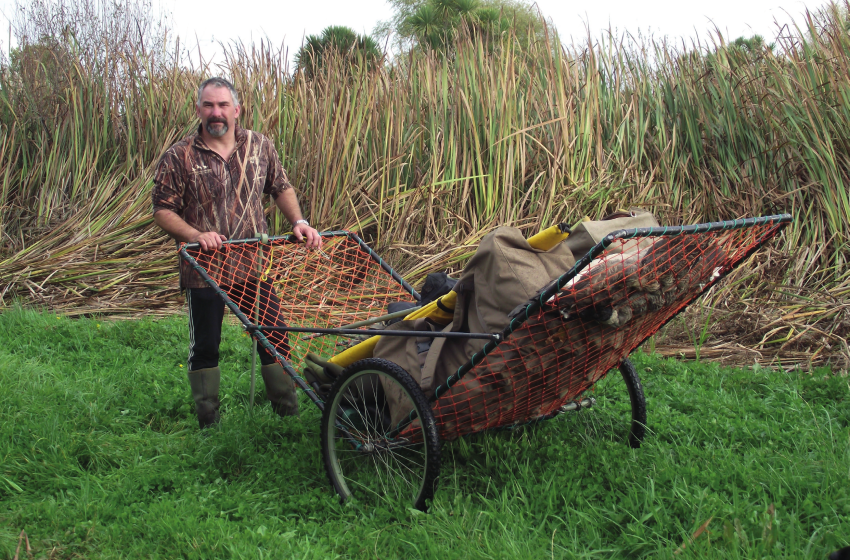
I once saw a video of a deer carry cart being used by a US hunter. "That'll make a great hauler cart for decoys and bags," I thought. Rummaging around the shed I used an old bike, along with parts from other failed projects, to make a break-down cart that I can put in the ute and then use at the wetland to easily push my gear around the tracks.
Watching YouTube hunting videos is all well and good but nothing truly beats hanging out with other keen (read: obsessed) duck hunters to discover ingenious hacks.
I've been fortunate to have hunted in many areas throughout the country. Typically, I annually hunt most North Island regions and try to squeeze in a couple of South Island hunts too. For a few seasons now, I've stayed at a private lodge at Lake Ellesmere, owned by well-known hunter and all-round good bugger Terry Lassen, with whom some illustrious and well-known Kiwi hunters vacation.
During these sojourns I've observed, discretely spied, and blatantly asked what works and how to be successful. I've gleaned heaps from these experienced hunters such as using line stakes rather than weights, especially the method utilising an old spade handle to spike them into the lake bed, rather than freeze your arm off in the cold water (cut sections of PVC are okay but can break with the pressure of removing them).
Shooting from one of the numerous maimais on Lake Ellesmere last year, I came across one with a really smart way to hang your ducks. It is an ingenious design that doesn't use nails (which can rip your waders) and is a good way to keep track of how many birds have been downed. You simply poke the duck's head through a hole in the rack and then slide the neck along a narrower slot which then holds the bird in place. This may be standard fit out for maimais down south but I'd never seen one and have promoted it ever since. At the 2025 Sika Show, this rack system I put in the Fish & Game maimai prop for our stand display got plenty of attention!
Being employed at Fish & Game as a wetland specialist for 22 years, I've seen plenty of ingenuity beyond duck harvesting. From gravity-fed feed tubes, to pond construction, to water structures, many hacks I've come across are quintessentially Kiwi and would not be seen anywhere else in the world.
That said, I was fortunate to be part of an exchange in 2010 and visited California to experience their wetland management. I came away with some great ideas for better wetland creation and enhancement and, of course, had to adapt to allow for our comparatively very limited budgets.
One of these hacks was modifying a weir riser that we historically use, changing the outlet location to enable native fish passage. A mate of mine made the mold for these concrete weirs and we've been successfully installing them in wetlands throughout the North Island ever since.
I'm constantly inspired to create or modify others designs to suit my hunting circumstances and continue to dream up the elusive 'duck magnet'. But in most cases my hacks are about making life easier, better and more enjoyable when out duck hunting. It's a big part of the pursuit for me. It keeps me in the game and thinking about duck hunting well beyond the weeks of the season itself.
Keen duck hunters are true dreamers and schemers. There's always something to play with or potter away at in the shed in preparation for next season. Being Kiwis, we 'make' rather than buy, and that's the fun in it. Hacks are part of our mentality but, just like me, you most likely need a tame welder or sparky ... and of course a patient 'better half'.
Disclaimer:
The information presented in these news items is based on the context and regulations in place at the time of publication. Please note that some articles may include reference to laws and regulatory standards that have since changed. For the most current and accurate information please check our Fishing Licences & Regulations pages or our Hunting Licences & Regulations pages.