Hunt the Humble Muck Pond
- 13/05/2026
Written by Ian Phillips
Our family moved to Southern Taranaki from the Rotorua area in September 2012. I am a very passionate duck hunter, so before we came down I made contact with Allen Stancliff from the regional Fish & Game office – I realised very quickly that hunting down here would be a lot different to what I was used to in Bay of Plenty.
We had started to shoot dairy farm effluent ponds before we left the Rotorua region, using layout blinds and decoys. The duck population in the area we hunted was pretty low but occasionally we had some really good hunts.
For the first three years we were here we returned to our Opening Weekend spot in Bay of Plenty. We had been hunting there for a long time and it was a tradition. During the rest of the season we started to shoot effluent ponds close to home. I was starting to meet more local farmers and our list of spots was growing.
Most effluent ponds will have ducks on them at some stage, but some can have lots of ducks!
The most attractive ponds to birds are those that have low banks and short grass around the edge. Ducks love to hop out of the water and walk around or have a snooze.
It was during our first season here that we discovered some large effluent ponds that were holding quite a population of ducks. We had some very successful shoots there using layout blinds and decoys during the next three seasons, but were still going back to Bay of Plenty for Opening.
In 2016, we were unable to go back north for Opening and ended up shooting on the large pond. Even though it was an effluent pond, it was still Opening Weekend and we approached it as such. We had a maimai and a good spread of decoys, including a few goose floaters as there had been some around the ponds. These were all put out by canoe.
That first year was fantastic. We had some of the best hunting we've ever had on Opening Weekend. We have now shot there for nine Openings. Most have been good, one or two not so good. That can happen anywhere though.
So, if you are looking for an Opening Weekend possie consider checking out some effluent ponds, you could just strike gold...
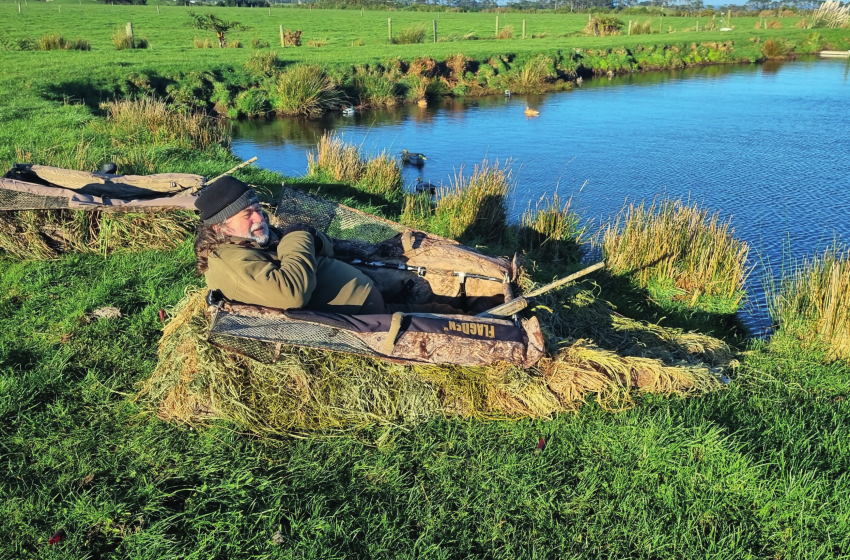
For the rest of the season, I shoot out of a layout blind. I look for ponds that are holding at least 40-50 ducks. When a pond has got those sort of numbers, there will be a lot of visible sign – lots of feathers, droppings around the edge and eaten or flattened grass.
Sometimes the birds may have been scared off so you haven't actually seen the ducks but looking for the clues you know they are using the pond regularly.
Another tip is to check out the pond at the same time you will be hunting. If they are in there at 9.00 am, it's safe to say they've come in that morning.
I won't disturb them and I try to have a shoot as soon as I can set up at the right time, usually within one or two days before their pattern changes and they disappear elsewhere.
I cover the blind the night before with fresh grass. It's easier than doing it the morning you plan to hunt. Arriving at the pond around 6.00 am, it doesn't take too long to set up. I throw out about six decoys; these are retrieved using a telescopic decoy pole. Then I set up the blind with my back to the wind if possible, ducks almost always land into the wind. The last thing you want is to have the birds coming in behind you.
If you don't have a dog, a long handled landing net or gaff is very handy to pick up harvested birds. Usually there is a breeze here in South Taranaki and they will be blown into the bank. Personally, I have never liked my dogs going into the ponds. They can pick them up in the paddock or around the edge.
Like other morning spots, there are some really early birds that come in before it is light enough to see. I quite often scare these off and hope they come back later. However, the majority of the ducks usually come in between 7.00-9.00. It can be pretty hectic at times, and it is easy to lose count. Sometimes you can have your limit in half an hour.
If you jump shoot a pond that has 50-100 birds on you will probably only get a few, and educate the others in the process. They will be a lot more wary next time. Why not instead set up a layout blind, throw out some decoys and have some real hunting success?
Hunting in effluent ponds in June can be very worthwhile, particularly if you find one that has been undisturbed during the season. These ponds can have a lot of ducks on them. However, their pattern can be completely different than it was in May.
As livestock are being break-fed in June, quite often the paddocks get churned up, especially if it's wet. This exposes a lot of worms which the ducks love. This is the time you see the birds all over the pasture and quite often right behind the cows.
At this time of the season, ducks will sometimes spend the night on an effluent pond and fly out in the morning to feed on the paddocks. So this is the opposite of what they do prior to animals being break-fed. They love worms and take full advantage of these conditions.
If you have set up on a pond you will probably still get some birds come in early. Take advantage of these while you can. My observation has been that when they are feeding in the paddocks they can keep coming back to the ponds throughout the day. So it is a good idea to pack up later. It's quite depressing when you've got back to the vehicle and the birds start pouring in.
We do not have many wetlands in our part of the world. But we certainly have an abundance of effluent ponds. They can provide a lot of hunting opportunities, so don't overlook the humble muck pond.
---
ADDITIONAL NOTES ON HUNTING EFFLUENT PONDS
By Fish & Game staff
Hunting effluent ponds has historically provided plenty of opportunity to harvest ducks.
Many regions in New Zealand still enable two or three-stage effluent ponds where the first pond captures the sludge and higher quality, less sediment-laden waters flow into the second pond, before being irrigated to pasture.
The first pond should never be shot over as retrieving birds is high risk, for both hunter and dog. Crusted ponds are extremely unsafe.
The second or third pond is high-nutrient waters with some pathogens but is generally wadable or swimmable for dogs. However, we do suggest instead that you wait for wind to blow birds to the pond sides, use an extendable pole, or use a grapple and line for retrieval.
More recent pond designs are steep and lined so these are more dangerous for hunting over. Always be smart, and stay safe.
Birds shot over the effluent ponds are fine to eat, as long as you adhere to good cleaning after breasting or plucking. Pellet holes require thorough washing, and for good hygiene make sure you clean your hands well.
Any bird ingestion of 'nasties' from the pond stay within the gut system, so they don't affect the flesh or pose a human health risk.
Some hunters say they'd never eat ducks from effluent ponds. But chances are, that's exactly where those birds that decoy into your hunting possie have come from. Same water, different site.
As the article states, effluent ponds provide a great opportunity to harvest ducks in a different environment – just take extra care dressing the birds and be sure to clean them well.
Disclaimer:
The information presented in these news items is based on the context and regulations in place at the time of publication. Please note that some articles may include reference to laws and regulatory standards that have since changed. For the most current and accurate information please check our Fishing Licences & Regulations pages or our Hunting Licences & Regulations pages.