Back to Fishing Knowledge Hub
Fishing access
Across New Zealand there are hundreds of accessible fishing locations.
There are multiple ways for anglers to identify these access points. These include online mapping tools, on-the-ground signage, printed regional resources, and regional Fish & Game staff, all of which can help anglers locate access points and plan fishing trips.
Guides
Online access maps
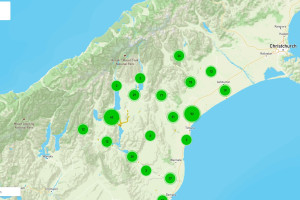
Each region provides online access maps showing legal public access points and areas where Fish & Game has negotiated access on behalf of anglers.
These are useful tools for identifying where fishing access is permitted and can help with planning trips in advance. It can be helpful to save the relevant regional access map link on your cell phone for easy reference while travelling. Click on the links below to access the online access maps for the different Fish & Game regions.
| Northland | Auckland / Waikato | Eastern |
| Hawke’s Bay | Taranaki | Wellington |
| Nelson / Marlborough | West Coast | North Canterbury |
| Central South Island | Otago | Southland |
Angler access signage
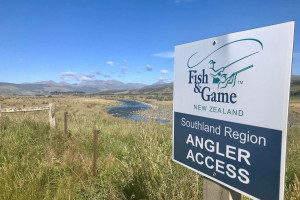
Our blue and white angler access signs are one of the easiest ways to identify fishing access locations while in the field.
These are commonly seen when travelling near rivers and lakes. Signage ranges from basic access signs with Fish & Game branding, through to detailed site-specific signs showing how to access a particular fishing area. Some sites also include maps and information on access etiquette. It is important to always follow the instructions provided on the access signage.
Hard copy brochures
Fish & Game offices, and some sporting retailers, provide printed brochures containing maps and fishing information for different fisheries within each region.
These are free of charge and can be a useful hard-copy quick reference to keep in a vehicle for trip planning.
Fish & Game staff
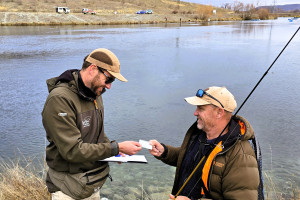
Regional Fish & Game staff are a valuable source of information when planning a fishing trip.
They are very familiar with their local area and are always happy to provide advice on access, as well as general fishing tips and current local conditions. Anglers can contact their local Fish & Game office by phone or get in touch via email or social media. Visiting an office in person is also a great option for speaking with staff directly, accessing physical maps and up-to-date information on fisheries and access.
Contact information per region
| Northland | Auckland / Waikato | Eastern |
| Hawke’s Bay | Taranaki | Wellington |
| Nelson / Marlborough | West Coast | North Canterbury |
| Central South Island | Otago | Southland |