Back to Fishing Knowledge Hub
What you could catch
From trout to perch, discover what’s in our waters.
New Zealand offers anglers the opportunity to target a variety of freshwater sports fish species, each providing a different fishing experience.
Freshwater sports fish can be divided into two groups: salmonids and coarse fish. Salmonids include trout and salmon, while coarse fish include species such as redfin perch and tench. The species present will vary depending on where you fish, with different waterways supporting different fish populations.
Guides

Salmonids
New Zealand’s freshwater sports fisheries are dominated by salmonid species introduced from Europe and North America over 150 years ago.
These species are highly valued by anglers for their sporting and eating qualities, with several species widely distributed throughout the country.
Brown trout (Salmo trutta) 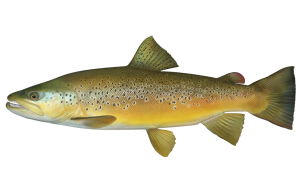 Brown trout are the most widespread salmonid in New Zealand, found in rivers, lakes, streams, and estuaries throughout both islands. They typically range in colour from olive-brown to golden with black and red spots along their flanks, often becoming darker and more bronze during spawning. Some fish also spend time in the sea, where they can become bright silver in appearance. Behaviourally, they are generally cautious and selective feeders, taking a mix of insects, crustaceans, and small fish. They are highly regarded as a table fish, with firm, mild-flavoured flesh that is often orange in colour. Brown trout are also known for their strong, determined fight, often heading for cover or structure when hooked.
Rainbow trout (Oncorhynchus mykiss)
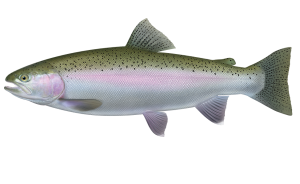
Rainbow trout are widely distributed throughout New Zealand and are especially common in lakes as well as river systems where lakes are present within the catchment. They are easily recognised by their bright silvery body and distinctive pink to red lateral stripe, with scattered black spots across the body and fins. Compared with brown trout, rainbows are generally more aggressive feeders and can often be easier to catch. They feed on similar food items to brown trout and are considered an excellent eating fish. When hooked, rainbow trout are known for their energetic fight, often making strong runs and leaping clear of the water, making them a very exciting species to catch.
Chinook salmon (Oncorhynchus tshawytscha)
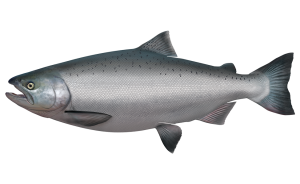
Chinook salmon are a highly prized species among anglers and are generally regarded as one of the best eating freshwater fish in New Zealand. Population strongholds exist in Canterbury’s braided rivers and hydro canal systems, with smaller runs occurring in large rivers throughout the South Island. Landlocked populations of Chinook also exist in some lakes, and some put-and-take fisheries are stocked with hatchery-reared fish. They are silver-bodied, with small black spots on the back and tail, becoming darker during their spawning migration. Chinook are powerful fish that put up a strong fight.
Sockeye salmon (Oncorhynchus nerka)
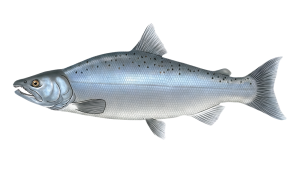
Sockeye salmon have a very limited distribution in New Zealand and are confined to a landlocked population the Lake Ōhau system in the Mackenzie Basin (Central South Island Region). They are silver in colour, but when entering rivers to spawn they develop a striking bright red body with a green head. Sockeye are highly regarded as an excellent eating fish. They are strong for their size and provide a good fight.
Brook trout (Salvelinus fontinalis)
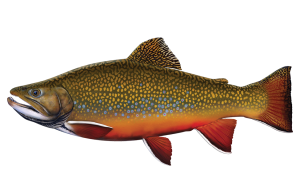
Brook trout are not widely distributed in New Zealand but are found in some small streams and lakes where other trout species are absent. Despite their name, they are a char rather than a true trout and are easily identified by their dark olive-green to brown body, pale worm-like markings along the back, and distinctive red and blue spots with white-edged fins. These attractive markings make them highly regarded by anglers. They feed opportunistically on aquatic insects and small invertebrates and, despite their generally smaller size, fight well when hooked.
Tiger trout (Salmo trutta × Salvelinus fontinalis)
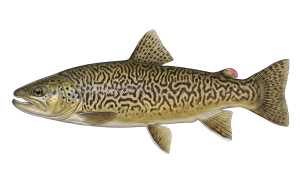
Tiger trout are a sterile hybrid between brown trout and brook trout and are present in Lake Rotoma near Rotorua where they are stocked for angling purposes. They are easily recognised by their striking maze-like markings across the body, giving them a bold, distinctive appearance. Tiger trout are aggressive, feeding on invertebrates and small fish, and are valued for their novelty. When hooked, they are strong fighters.
Must read Before you fish
Coarse Fish
New Zealand’s freshwater sports fisheries are dominated by introduced salmonid species but also include some non-salmonid sports fish. These species are less widespread than brown and rainbow trout but can provide interesting and varied angling opportunities.
Redfin Perch (Perca fluviatilis)
Redfin perch are found in lowland lakes, ponds, wetlands and slow-flowing rivers across the country.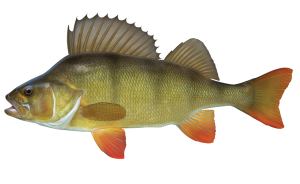
They are easily identified by their olive-green and golden bodies, vertical dark bars along their flanks, sharp dorsal fins and bright red/orange fins. Perch are highly aggressive, feeding on aquatic insects and crustaceans when small and small fish as they get larger. They often form shoals when young and become more solitary as they grow. They are easy to catch and are excellent eating with firm white fillets that are mild in flavour. When hooked, large perch can provide a good fight.
Tench (Tinca tinca)
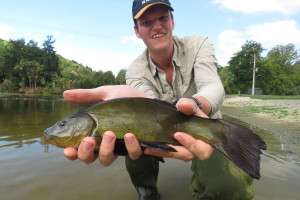
Tench are a bottom-dwelling species found in slow-moving rivers, lakes, and wetlands, mainly in the North Island but there are some small populations located in the South Island.
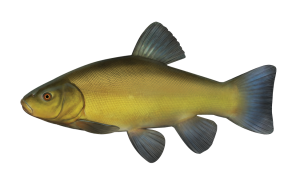
They have a distinctive olive-green to dark bronze body and small red-orange eyes. Tench prefer still waters with soft substrates where they feed on molluscs and insect larvae. When hooked, tench will put up a steady fight.
Rudd (Scardinius erythrophthalmus)
Rudd are a small fish species found in some North Island lakes and slow-flowing waterways. They are a sports fish in the Auckland/Waikato Region only.
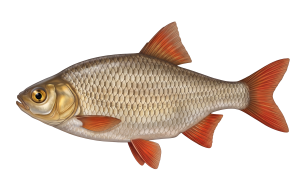
They are bronze-gold in colour, with a distinctly upturned mouth and bright red fins. Rudd feed mainly on aquatic vegetation and insects. They are not generally targeted for eating or sport but can provide light angling opportunities, particularly for beginners. When hooked, rudd are lively, with quick darting movements.