Back to Fishing Knowledge Hub
Fishing from boats – Harling
Long before fish finders, lead-core lines and downriggers became common, anglers were catching trout consistently using a simple technique known as harling.
Although this traditional fishing technique has been somewhat overshadowed by modern trolling methods, harling remains an effective way to target trout in New Zealand lakes. It requires minimal equipment, works particularly well in shallow water, and provides an active way to fish from a boat.
Guides
What is harling?
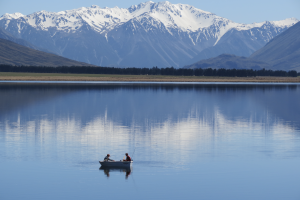
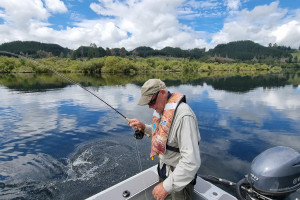
Harling is the practice of slowly pulling one or more feathered lures (streamers) behind a moving boat.
Unlike trolling with diving lures or weighted rigs, harling relies on the slow forward movement of the boat to give the flies a natural swimming action.
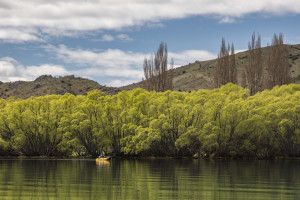
Traditionally, anglers using the harling method rowed quietly around lake margins while trailing flies 20 to 40 metres behind the boat. Today, many anglers use electric motors or idle a small outboard, although rowing still provides exceptional control and keeps water disturbance to a minimum. Because the flies fish close to the surface, harling is most effective whenever trout are feeding in the upper few metres of the water column.
Choosing the right water for harling
Harling is most effective over relatively shallow areas where trout naturally patrol.
Some of the best locations include:
- Weed edges
- Litoral areas (rocky shorelines)
- River mouths
- Drop-offs into deeper water
- Areas of submerged structure (logs, large rocks)
- Areas where wind pushes food onto the shore
Rather than rowing aimlessly across open water, when harling, concentrate on following the contours of the lake and fishing likely holding areas thoroughly.
Tackle for harling
Harling requires surprisingly little specialised equipment. A 9-foot fly rod rated for a 6 or 7-weight line is ideal.
Floating lines remain the most versatile choice, particularly during spring and autumn. Intermediate or slow-sinking lines are useful when trout are feeding slightly deeper.
Leaders between three to five metres in length provide a natural presentation and keep the fly line away from any fish that are investigating your fly. You can use a single fly, or a series of flies (two or three) spaced around one metre apart.
Must read Before you fish
Choosing flies for harling
Traditional feathered lures (streamers) remain exceptionally effective for harling because they imitate the small fish that trout feed on.
Top choices include:
- Grey Ghost
- Parsons Glory
- Mrs Simpson
- Hamill's Killer
- Jack Sprat
- Alexandra
- Craig's Night Time
Small woolly buggers and modern baitfish patterns have also become increasingly popular. In clear water, silver, olive, grey and white colours usually perform well. On dull days or in coloured water, darker flies with touches of orange or fluorescent materials can provide greater visibility.
It is always forth carrying several patterns so you can try different flies until you find the fly that works on a given day.
Boat speed when harling
One of the key factors for successful harling is a slow boat speed. The flies should swim naturally rather than being dragged quickly through the water.
When rowing, the correct speed often develops naturally. If using an electric motor, select the lowest practical setting. The flies should pulse gently with the movement of the water rather than spinning or skipping across the surface. Occasional changes in speed or gentle turns create subtle changes in fly action that can cause a following trout to strike.
Fly presentation when harling
After letting the flies out behind the boat (20-40m), allow them to work undisturbed. Avoid continually retrieving and recasting.
Instead, concentrate on maintaining a steady course while watching the shoreline, wind direction and for underwater structure.
Try to incorporate long sweeping turns into your travel. This will cause an outside fly to accelerate through the turn while an inside fly will slow down. This change in fly speed can often trigger a trout to strike.
Another approach is to weave gently in and out from the shoreline. This allows the flies to cover varying depths during each pass.
Detecting takes when harling
Trout often take harled flies surprisingly gently.
Sometimes the line simply tightens. Other times the rod tip dips steadily as the fish realises it has been hooked. Rather than striking hard, simply lift the rod smoothly and allow the fish to hook itself against the steady forward movement of the boat. Maintaining constant pressure is far more important than an aggressive strike.
Harling with modern technology
Harling is a traditional fishing technique that has been used for generations, but modern electronics have made it easier to locate fish and consistently target productive areas.
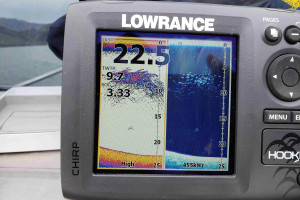
Fish finders can reveal underwater features such as weed beds, drop-offs and changes in depth, as well as concentrations of baitfish and trout. These areas can then be targeted with a harling run. Modern GPS mapping also allows anglers to identify and record productive harling runs. Once a successful area or route has been found, it can be marked and repeated, making it easier to consistently fish the most productive water.
Although these modern electronics are not essential for successful harling, they can greatly improve your ability to locate productive water and repeat successful fishing runs, ultimately increasing your chances of catching fish.