Back to Fishing Knowledge Hub
Coarse fishing
Target perch, tench, and rudd using specialised techniques.
Coarse fishing is another freshwater fishing option available in New Zealand. While it is not commonly practised, there is a small but dedicated group of coarse anglers who enjoy targeting species such as perch, tench and rudd using specialised coarse fishing methods.
Guides
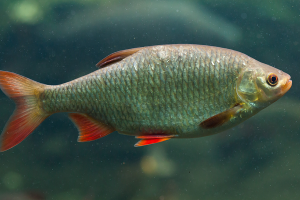
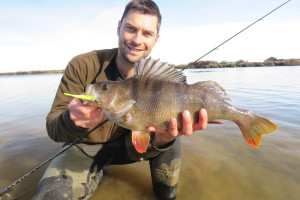
What is coarse fishing?
Coarse fishing is a style of freshwater fishing that uses specialised techniques and equipment to target coarse fish species in designated coarse fishing waters. Regulations for these fisheries differ from those that apply to trout and salmon fishing. Anglers may use specific coarse fishing tackle, a wider range of baits and attractants such as groundbait to encourage fish to feed in the area being fished.
While specialised coarse fishing equipment can be used in designated coarse fisheries, coarse fish species, such as perch, can also be successfully targeted using standard trout fishing gear and techniques, including natural bait and soft baits.
Always check the Fish & Game angling regulations before using coarse fishing methods to ensure they are permitted.
Recommended equipment for tench fishing
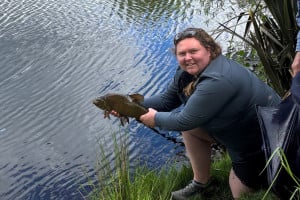
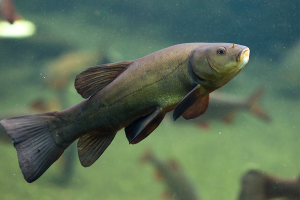
Tench are the species most commonly targeted using coarse fishing methods. Many anglers will get started using their existing trout fishing equipment, with only a few additional items required.
If you would like to target tench, see the list below for recommended equipment.
- Rod – A 2.7–3.3 m (9–11 ft) spinning rod is suitable for most tench fishing situations. Many anglers will start by using their existing trout spinning rod (6.5-7 ft).
- Reel – A spinning reel spooled with 2–4 kg (6–8 lb) monofilament line is suitable for presenting most tench baits.
- Hooks – Size #10–18 hooks are suitable. The size used will depend on bait size.
- Floats – Waggler floats are commonly used for presenting baits while float fishing and allow anglers to detect subtle bites.
- Sinkers – Split shot can be used with float rigs, while 1oz sinkers are suitable for running sinker rigs when fishing on the bottom.
- Baits – Tench are not particularly fussy feeders and can be caught using a range of baits, including:
- Sweetcorn
- Worms
- Maggots
- Bread
- Ground bait (berley) such as breadcrumbs, salmon pellets, or chicken feed can be used to attract tench to the immediate area you are fishing.
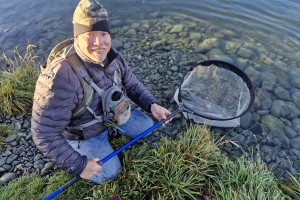
- Landing net – A landing net with a large frame and soft mesh is recommended.
- Unhooking mat – An unhooking mat provides a safe surface for handling fish and helps protect tench from injury.
- Pliers/forceps – Used to remove hooks.
- Bait bucket – Useful for mixing and carrying bait and ground bait while fishing.
- Folding chair – Provides comfort while waiting for a bite.
Where to find tench
Tench are widespread in New Zealand, although their distribution can be highly localised.
They are typically found in still or slow-flowing waters such as lakes, ponds, drains, and backwaters with abundant aquatic vegetation. They are primarily bottom feeders, searching through soft sediments for insect larvae, worms, snails, and other aquatic invertebrates. One of the most reliable ways to locate feeding tench is by watching for patches of fine bubbles rising to the surface. These bubbles are produced as tench disturb bottom sediments while foraging and are often seen around weed beds and other types of cover.
There are populations of tench located in four Fish & Game regions: Auckland/Waikato, Wellington, North Canterbury and Central South Island. Contact the local Fish & Game offices in these regions for information on the best spots to try.
Tench fishing basics
Tench are best targeted by fishing close to cover using simple tackle. They can be targeted using a floating or a bottom-fishing rig.
Floating rig
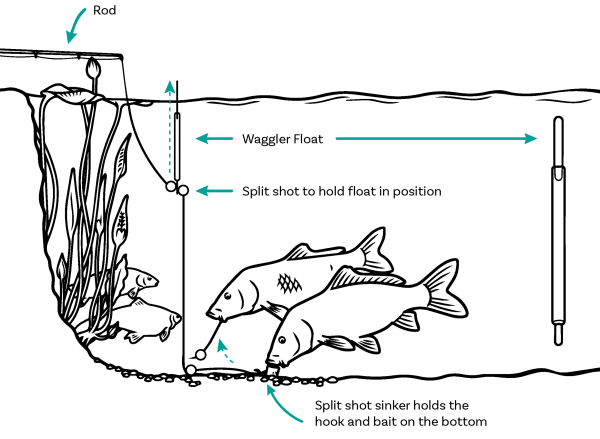
A simple float rig for tench uses a spinning reel with 4–8 lb monofilament line and a light rod. A waggler or stick float is attached to the line and held in place with small split shot, adjusted so the float sits upright with just the tip showing with the hook sitting on the bottom of the river or pond. Effective baits include sweetcorn, worms, maggots, and bread. Cast out near weed beds, reed edges, or other cover, then let settle with a slightly tightened line. When a tench takes the bait, the float will usually dip under the water, making bites easy to see.
Bottom fishing rig
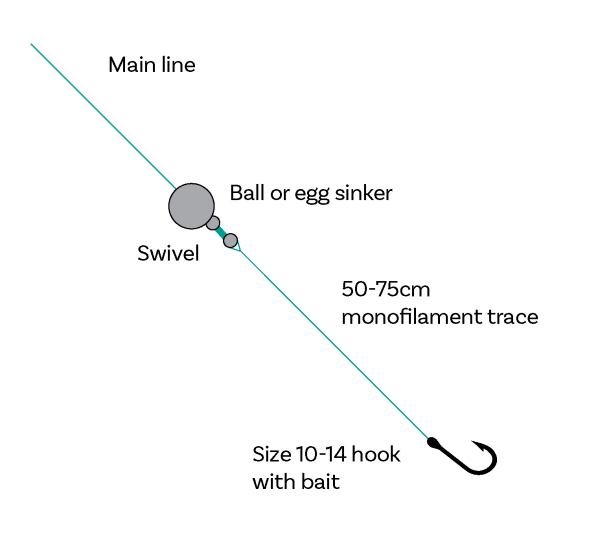
A simple running sinker rig is an alternative bottom-fishing setup. It is best fished in areas without much weed. Threaded onto the mainline is a ball or egg sinker. This is a running sinker which can slide freely on the main line. At the end of the line, a small swivel is tied to stop the weight sliding further down the line and to connect a length of lighter line (hooklength) which would typically be 3-6lb breaking strain and approximately 50-75cm in length. A small size 10–14 hook baited with sweetcorn, worms, maggots, or bread is tied to the hooklength. The bait sits directly on the bottom where the tench are actively feeding.
Once on the bottom, the line is kept lightly slack or just slightly tensioned, with a rod rest used to hold the rod in position. Bites are usually seen as a slow pull of the line or a sharp movement of the rod tip.
Regardless of the rig used, introducing a small amount of bait or groundbait to the fishing area can help attract and hold fish.
Other coarse and non-sports fish species
In addition to tench and perch, New Zealand supports several other introduced freshwater fish species that can provide recreational angling opportunities.
Rudd are widespread throughout much of the North Island and occur in several isolated populations around Christchurch. A sportfishing licence is required for rudd in the Auckland Waikato Fish & Game region only. Outside of this region, no licence is required.
Rudd are found in lakes, ponds, drains, wetlands, and slow-flowing waterways with abundant aquatic vegetation. Unlike tench, which feed primarily on the bottom, rudd often occupy the mid-water and upper-water layers and are frequently associated with weed beds, where they feed and seek shelter. During calm conditions, rudd can sometimes be seen cruising near the surface, particularly around the edges of aquatic vegetation.
Rudd are opportunistic feeders, consuming a mixture of aquatic plants, algae and insects. They can be readily caught using simple float-fishing techniques, with effective baits including sweetcorn, bread, maggots, and worms. Clear patches of open water adjacent to weed beds, channels through vegetation, and the margins of reed beds are often productive fishing locations. In clear water, rudd can sometimes be sighted feeding beneath the surface or moving through gaps in the weed. Rudd often occur in schools and once located, multiple fish can often be caught from the same spot.
Other fish that may be encountered when targeting coarse fish include goldfish, koi carp, brown bullhead catfish, and grass carp. Some of these species, particularly koi carp and catfish, are invasive pest fish and must not be returned to the water once captured.
Targeting perch
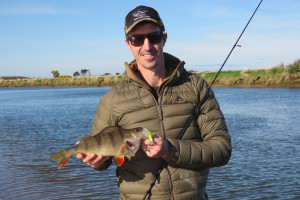
Perch are commonly found in many New Zealand lakes, wetlands, and rivers, and they can provide excellent fishing opportunities for anglers of all ages and experience levels.
Unlike some coarse fishing species such as tench and rudd, perch do not require specialised coarse fishing gear. In most cases, a standard light spinning rod used for trout fishing is perfectly suitable.
Perch are aggressive feeders and will readily take a range of lures, soft baits, and natural baits. Success often comes down to getting your bait or lure down to where the fish are holding. In many situations, perch will be close to the bottom, so fishing your bait or lure on/near the bottom of the lake, river or pond is important. They are also strongly structure-oriented fish and are commonly found around weed beds, submerged logs, rock piles, jetties, and other features that provide cover and feeding opportunities.
When bait fishing for perch, it is important to make sure you use enough weight to ensure your bait reaches the bottom and stays there. Worms and dead smelt are both highly effective baits for perch.
When spin fishing, soft baits are one of the most effective options. They sink easily to the bottom and can be fished effectively by slowly bouncing them along the bed of the river or lake. A simple and effective approach is to cast out into likely areas, allow the soft bait to sink, then use a series of small lifts and pauses to work it along the bottom while maintaining contact with the lure.
One of the great things about perch fishing is that perch often school together. Finding one fish can often lead to catching more from the same area. Sometimes, when a perch is hooked, other perch in the school will follow it towards the surface. This can create an excellent opportunity for a fishing companion to cast a soft bait near the hooked fish and the rest of the school, often resulting in another quick hookup. Likewise, quickly unhooking and recasting after catching a perch can often result in another fish being caught while the school remains active in the immediate area.